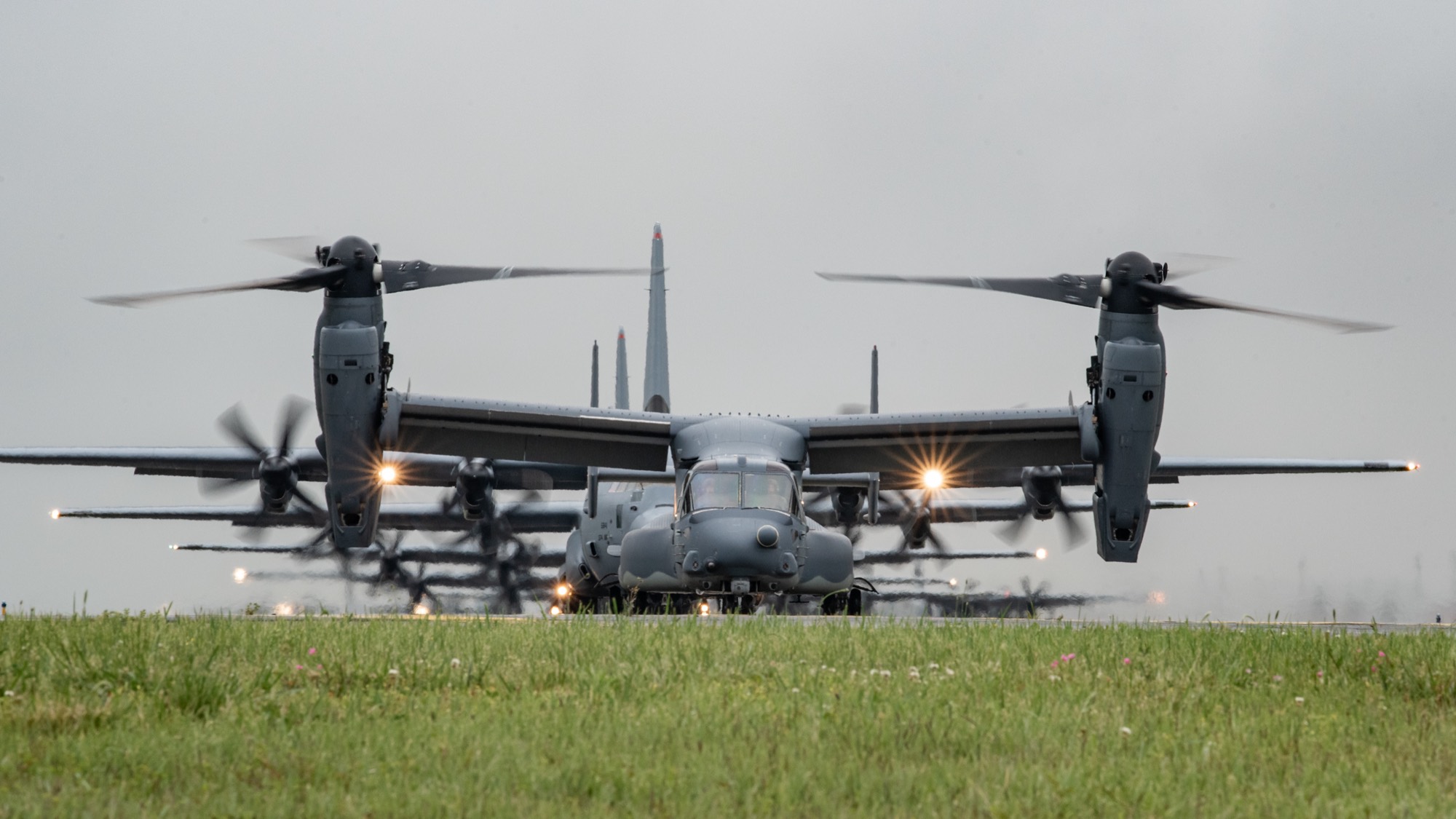
The Osprey record: thirty five years of accidents
The V-22 Osprey has lost 21 airframes and 62 lives since 1991. We have added the full record to the database. What stands out is not how many accidents there have been, but how little they have in common.
We have just completed the V-22 Osprey record in the database, from the first prototype loss at Wilmington in 1991 to the grounding that followed Yakushima in 2023, and on to a fire in a North Carolina forest in 2026. Twenty one airframes, 62 lives.
The Osprey has a reputation, and reputations are hard to argue with. What the record actually shows is stranger than the reputation suggests. Twenty one accidents, and almost no two of them killed people the same way.
The numbers
More than half the deaths come from three accidents: Marana in 2000, Yakushima in 2023 and the Potomac in 1992. The rest are spread thinly across nine more, and nine of the twenty one losses killed nobody at all.
The prototypes
The first two losses were pre-production aircraft, and both were caused by things that had nothing to do with flying a tiltrotor.
In June 1991, aircraft number five lifted into a hover at New Castle County Airport on its first flight after maintenance. Two of its three roll rate gyros had been wired with reversed polarity, so the aircraft rolled the wrong way when the pilot corrected it. The left nacelle hit the ground from about fifteen feet and the aircraft burned. Both crew walked away.
Thirteen months later, aircraft number four was on a ferry flight approaching Quantico when flammable fluid that had pooled in the right nacelle ignited. All seven on board were killed in the Potomac River. Leaking fluid and a hot nacelle is an accident that could have happened to any aircraft. It happened to this one at the worst possible moment politically, with the programme already fighting for its life.
2000
The year that nearly ended the programme produced two fatal accidents and three lost airframes.
On 8 April, an MV-22B on a night approach to Marana Northwest Regional Airport, flying a simulated embassy evacuation, came down too fast and too steeply and entered vortex ring state. The right rotor stalled at about 245 feet and the aircraft rolled over. Nineteen marines were killed. It remains by some distance the worst accident in the Osprey record, and the only one to kill more than ten. A second aircraft parked nearby was written off by the fire.
Eight months later, on 11 December, a hydraulic line in the right nacelle of another MV-22B burst after chafing against a wiring bundle. The crew reset the primary flight control system repeatedly, as the checklist told them to, and a software fault turned one of those resets into a sudden pitch command. The aircraft fell sixteen hundred feet and came down in woodland near New River. All four on board died.
Two accidents, two completely unrelated causes. One a handling limit nobody had properly briefed, the other a wiring and software problem. The type was grounded for seventeen months.
The long middle
Between 2001 and 2009 the record shows almost nothing, which is the part of the story that rarely gets told. The aircraft was redesigned, requalified and sent to Iraq in 2007. The only loss in that stretch was an unoccupied MV-22B that lifted off by itself during post maintenance checks at New River in 2006, after a miswired cannon plug to the engine control unit commanded full power. It fell back and broke off its own starboard wing. Nobody was hurt.
Afghanistan, and the limits of investigation
In April 2010, a CV-22B crashed on a night approach near Qalat in Zabul Province, killing four of the twenty on board. The accident investigation board identified low visibility, a poor approach and a high rate of descent, and then did something unusual: it declined to name a single cause. The record carries that as unknown, because that is what the board concluded, and we would rather the database say so than pick the most plausible sounding option.
The sea
Four of the twenty went in the water, and all four for different reasons.
Off Okinawa in December 2016, a proprotor blade struck the refuelling hose of a KC-130 during night aerial refuelling. The crew put the aircraft in shallow water east of Camp Schwab and it broke up. Two of the five on board were injured.
Off Shoalwater Bay in August 2017, an MV-22B approaching the flight deck of USS Green Bay settled in its own downwash, struck the ship and went in the sea. Three of the twenty six on board were killed. The investigation found the aircraft was too heavy and criticised how the survival equipment had been managed.
Off Bahrain in October 2014, an aircraft was started in maintenance mode by mistake, which left the exhaust deflector engaged and cost about twenty percent of engine power. Two crew jumped as it sank towards the water. The pilot recovered and landed. One of the two who jumped was never found.
Hard clutch engagement
Glamis, California, June 2022, is the accident that reads worst in hindsight. A dual hard clutch engagement destroyed the proprotor gearbox and five marines were killed. Hard clutch engagement was not a surprise. It had been documented for years, it had happened repeatedly without killing anybody, and the redesigned input quill assembly that followed could have been fitted earlier.
Yakushima
On 29 November 2023, a CV-22B transiting off Yakushima suffered a catastrophic proprotor gearbox failure, the left nacelle caught fire, and the aircraft rolled inverted and came down in the East China Sea. All eight crew were killed. The accident investigation board traced it to cracking in a high speed planetary pinion gear, a failure mode with no precedent in the fleet, and also found that the crew had continued the flight after chip burner warnings rather than landing. The type was grounded worldwide a week later.
Bladen County
On 8 October 2026 an MV-22B of VMM-162, the Golden Eagles, from Marine Corps Air Station New River, was one of a flight training near a disused forestry airstrip in Bladen Lakes State Forest, North Carolina, when a fire broke out on board. The crew put it down hard near the Pappy Tatum landing zone, about fifty miles west of Camp Lejeune, with roughly 6,000 pounds of fuel aboard. It was still burning that afternoon, with six or seven fire departments holding the area. One marine was airlifted to a burn centre at Chapel Hill, the other three on board were unhurt, and the aircraft was destroyed.
The cause of the fire is under investigation, so there is nothing to conclude from it yet. Two things are worth noting all the same. It is the first Osprey airframe lost since the worldwide grounding that followed Yakushima. And it is the ninth of the twenty one losses to kill nobody, which is the half of this record the reputation never carries.
One correction worth making, because it spread quickly. Several national outlets reported four injuries. That came from a Marine Corps statement saying four personnel were aboard and were receiving medical care, which is routine language after an accident rather than an injury count. The fire chief on scene said one marine was burned and three were unhurt.
What the record actually shows
Twelve fatal accidents in thirty five years, and the causes barely repeat. Vortex ring state. A chafed hydraulic line and a software reset. A nacelle fire on a ferry flight. Downwash over a ship's deck. A clutch. A pinion gear. Two cases of crews flying the aircraft beyond where they should have. And one the investigators looked at and declined to name.
That is not the signature of a bad aircraft so much as a complicated one. Compare it with what we see everywhere else in the database: helicopters hit wires, and they hit wires the same way, year after year, in every country, on every type. There are 170 wire strikes on record here, against twelve fatal Osprey accidents with barely a repeated cause between them. The Osprey record has no equivalent. Each accident taught something specific and mostly singular.
Whether that is reassuring depends on what you want from an aircraft that has been in service since 2007.
A note on scope
The V-22 is a tiltrotor rather than a helicopter, and whether it belongs in a rotorcraft database is a fair question. We include it, along with the AW609, because it takes off and lands on its rotors and the accident patterns that matter here, downwash, vortex ring state, gearbox and drive system failures, are rotorcraft patterns. Three of the records above are among the clearest examples of those failure modes anywhere in the database.
Full records for every accident above are in the database, with sources.
Figures as at 8 October 2026. The database is updated continuously as new records are added and investigations conclude, so current totals may be higher.